Hold’em on the Come Excerpt 1
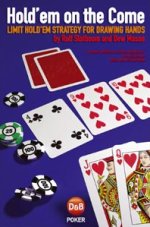 This week we’re going to be running some excerpts from professional Dutch player and author Rolf Slotboom’s recently released book. Rolf is an expert limit hold’em and Omaha player. He will be tackling pot-limit Omaha in his soon to be released book ‘Secrets of Professional Pot-Limit Omaha – how to win big – both live and online’. We’ll be bringing you excerpts of that when it’s released, but for now we’re starting with his excellent guide to playing draws in limit hold’em ‘Hold’em on the Come: Limit Hold’em Strategy for Drawing Hands’.
We have 5 signed copies of the book to give away, all you have to do is try to predict how many goals will be scored on the opening day of the Premiership football season, which kicks off this Saturday. For more information, click here.
Excerpt 1: Estimating The Number And Value Of Your “Outs”
Throughout the rest of the book, we will be calculating the value of several different kinds of hands, by making certain assumptions; in particular, we will want to estimate, as accurately as reasonably possible, the winning chances of each “out”.
Take a look at the chart below:
|
Hand Type |
Outs |
|
Flush Draw |
9 |
|
Open-Ended Straight |
8 |
|
Inside Straight |
4 |
|
Low Pair |
5 |
|
Overcard |
3 |
|
Underpair |
2 |
Here are six examples of drawing hands. These are the types of drawing hands we’ll focus on in this book. For each type, I’ve provided the number of outs left in the deck.
Flush Draw: If you have four cards to a flush, then nine cards remain (of the thirteen in each suit) that will complete your hand.
Open-Ended Straight: A hand like 6 7
7 8
8 9
9 can complete to a straight with any five or any ten. Eight outs left in the deck.
Inside Straight: A hand like 67 810
810 can complete to a straight only with a nine. Four outs.
Low Pair: By this, I mean the board pairs one of your cards, but it’s not top pair. You’ve paired either the middle card or bottom card on the flop. If you hold 89 and the flop is 8AK, you have five outs to make two pair or better (any eight or nine).
Overcard: If you hold AJ and the flop is 78Q , you hold one overcard (your ace). You have three outs (three more aces in the deck) to make top pair and a probable winning hand.
Underpair: You hold a pair in your hand, and flop one or more overcards. For example, you hold 6ª6© and the flop comes 2 JK. This is worse than a low pair, since you have only two outs to work with… the other two sixes.
The problem with these examples, of course, is that you don’t know whether your outs are any good. You don’t even know if you need the outs! There are always the same two complications when counting outs:
- You can make your hand and still lose.
- You can miss your hand and still win.
Let’s cut to the chase, then. What we really care about in these examples is the chance of winning. We do this by counting outs, but we adjust that count, usually downward, to account for the chance that it won’t be enough to win after all. Some fairly common examples of how this can happen:
- You can hit your overcard, but lose to two pair.
- You can make two pair, and lose to a straight.
- You can make a straight, and lose to a flush.
- You can make small flush on the turn, and another card of the same suit appears on the river, causing you to lose to a higher flush. For example, you can have 78 in your hand, and make a flush on the turn with A264 on the table. Then, another heart appears on the river, and you lose to a hand like A§Q.
It’s just not as easy to count outs as we would like it to be.
From this point forward in the book, we’re only going to be interested in something we’ll call modified outs. For example, let’s pretend that you have a hand with exactly six perfect outs. If you hit one of those six cards, you’ll always win; if you don’t, you’ll always lose. Wouldn’t life be wonderful if it were that simple?
It never is. If you had “perfect outs”, you would be able to calculate exactly how often you would win the hand. You can’t. But we’ll use this “perfect out” standard for valuing any hand you hold.
Calculating “modified outs” is usually about a three-step process:
- First, you search for and add up your outs in each hand.
- Then you subtract some of those outs because they are “compromised” (meaning, you still might not win even if you get the right card).
- Then maybe you’ll add outs for other reasons, such as a three-card flush or straight.
The end result, we hope, will be an approximate measure of the true value of your hand. If, for example, you calculate six “modified outs” on the turn, you expect the hand to win 13% of the time. Why? Because a hand with six perfect outs would win six times out of the 46 cards remaining in the deck. That’s 13%.
This is an excerpt from the brand new Rolf Slotboom / Dew Mason book “Hold’em On The Come – Limit Hold’em Strategy For Drawing Hands”. This book can be ordered through the Hendon Mob Book Store. More information is available on Rolf’s site www.rolfslotboom.com and also on the publisher’s site www.dandbpoker.com.